
The half-life of professional skills has dropped from 30 years in the 1980s to less than 5 years today. What you learned in university becomes partially obsolete before you finish paying off student loans. Meanwhile, the volume of published knowledge doubles every 12 months, creating an impossible challenge: staying relevant requires continuous learning, but the sheer volume of available information makes systematic learning feel overwhelming.
This is the central paradox facing knowledge workers in 2026. We know that lifelong learning isn't optional—it's survival. Yet most people approach reading and learning reactively, consuming whatever appears in their feed, saving articles they never revisit, and finishing books without retaining actionable insights. The problem isn't lack of motivation or intelligence. It's the absence of a systematic workflow that transforms scattered reading into compounding knowledge.
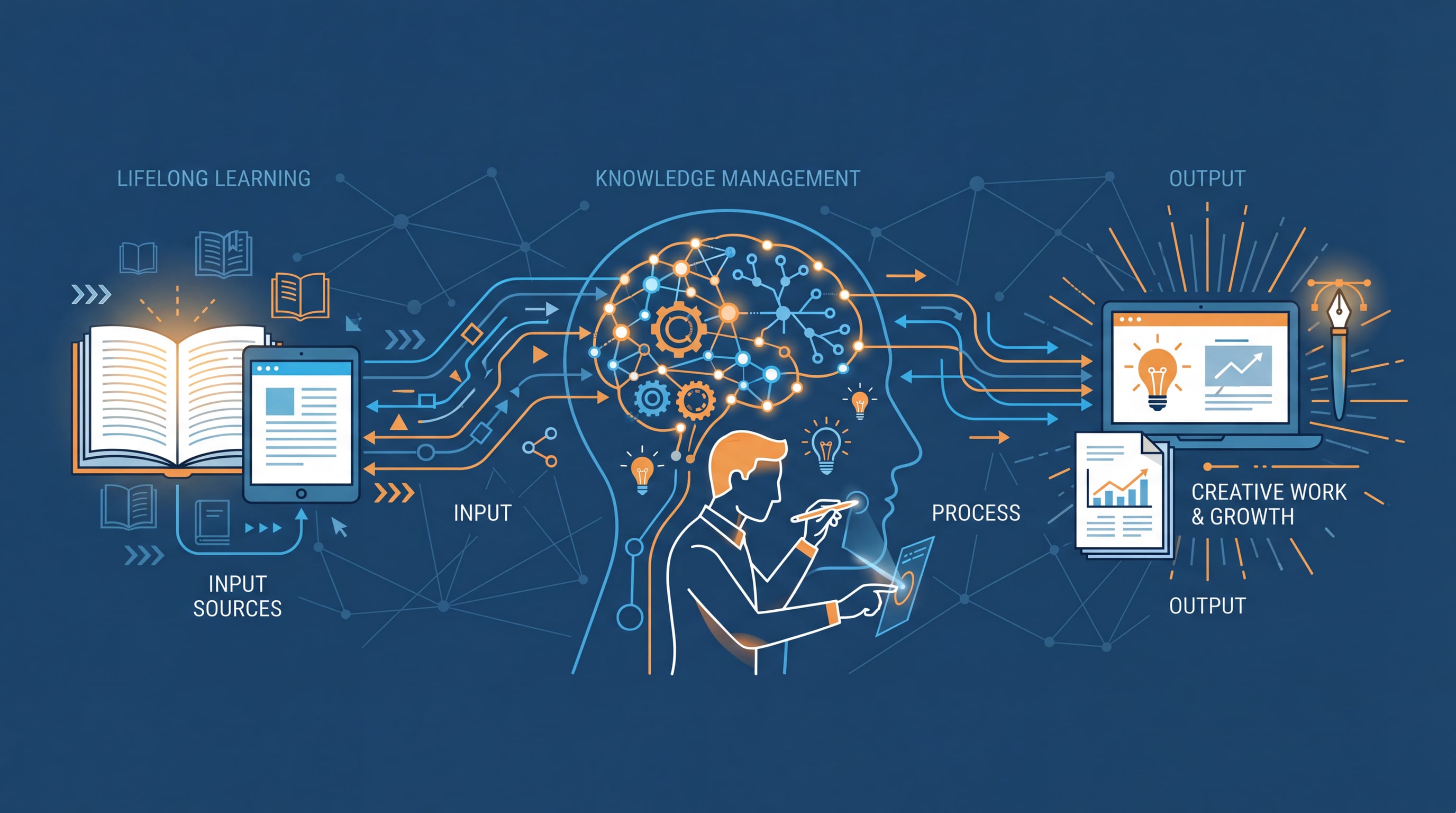
This guide presents a complete lifelong learning system built around a five-stage reading workflow: Discover, Filter, Read, Understand, and Apply & Share. Unlike generic productivity advice, this framework addresses the entire knowledge lifecycle—from finding valuable content to producing original work that demonstrates mastery. By implementing this system, you'll transform from a passive information consumer into an active knowledge creator whose learning compounds over time.
The Five-Stage Reading Workflow: From Input to Output
Effective lifelong learning requires more than reading more books. It demands a systematic process that ensures every hour invested in reading produces lasting value. The five-stage workflow creates a complete cycle where knowledge inputs become tangible outputs.
Stage 1: Discover – Building Your Knowledge Pipeline
The discovery stage determines the quality of everything downstream. Most people discover content passively through social media algorithms or colleague recommendations, resulting in a random, reactive learning diet. Intentional learners build curated discovery channels aligned with their learning goals.
Create Themed Discovery Channels
Rather than consuming whatever appears in your feed, establish 3-5 focused learning areas that align with your professional development or personal interests. For each area, identify 2-3 high-quality sources that consistently publish relevant content. A software engineer might track AI research papers, a marketing manager might follow growth strategy blogs, and an entrepreneur might monitor industry trend reports.
The key is intentional curation. Subscribe to newsletters from thought leaders in your field, follow specific subreddit communities, join professional Slack channels, and set up Google Scholar alerts for academic topics. This creates a steady stream of relevant content without the noise of general social media.
Leverage Network Intelligence
Your professional network represents collective intelligence far exceeding any individual source. Pay attention to what respected colleagues share and recommend. When multiple trusted sources independently mention the same book or article, that signal indicates genuine value rather than algorithmic manipulation.
Create a simple system for capturing these recommendations—a dedicated Notion database, a Slack channel for your team, or even a shared spreadsheet. The goal is preventing valuable recommendations from disappearing into chat history or email threads.
Balance Depth and Breadth
Effective discovery balances deep expertise in your core domain with broad exposure to adjacent fields. The 70-20-10 rule provides useful guidance: dedicate 70% of reading to your primary field, 20% to adjacent disciplines that inform your work, and 10% to completely unrelated areas that spark unexpected connections.
This balanced approach prevents both narrow expertise that misses important context and scattered learning that never builds deep competence. A product manager might read primarily about product strategy (70%), supplement with UX design and data analysis (20%), and explore psychology or behavioral economics (10%) for fresh perspectives.
Stage 2: Filter – Intelligent Prioritization Before Reading
Discovery generates more potential reading than anyone can process. The filtering stage separates genuinely valuable content from noise, ensuring your limited reading time focuses on high-impact material.
The Three-Tier Priority System
Not all content deserves equal attention. Implement a three-tier classification system:
Tier 1: Deep Read – Books and long-form content that merit full attention and note-taking. These address core professional skills, fill important knowledge gaps, or come highly recommended by multiple trusted sources. Expect to deep read 2-4 books monthly.
Tier 2: Skim Read – Articles and shorter books that provide useful context but don't require comprehensive absorption. These might cover adjacent topics, provide industry updates, or offer interesting perspectives without being immediately actionable. Skim read 10-15 pieces weekly.
Tier 3: Archive or Skip – Content that seemed interesting during discovery but doesn't align with current priorities. Archive these for potential future reference or skip entirely. Most discovered content falls into this category, and that's perfectly appropriate.
The 3-Minute Evaluation Protocol
Before committing hours to reading a book, invest 3 minutes in intelligent evaluation. This is where AI-powered book summary tools like 3MinTop provide exceptional value. Rather than the traditional binary choice—read the entire book or skip it completely—AI summaries introduce a third option: rapid surveying that reveals whether deep reading will repay the time investment.
Generate a 3-minute summary that captures the book's core argument, main supporting points, and practical applications. This quick overview lets you assess whether the book offers genuinely new insights or merely repackages familiar concepts. Users report this approach increases their effective reading volume 5-10x while actually improving comprehension of deeply-read material, since the summary provides a structural roadmap that guides focused reading.
For a book on leadership, the 3-minute summary might reveal it focuses on corporate hierarchy management—valuable for executives but less relevant for startup founders. This quick assessment saves hours that would be wasted on misaligned content.
Apply the Relevance-Impact Matrix
Evaluate potential reading along two dimensions: relevance to current goals and potential impact on your work or thinking. High-relevance, high-impact content becomes Tier 1. High-impact but lower relevance might be Tier 2 for future reference. Low-impact content, regardless of relevance, gets archived or skipped.
This matrix prevents two common mistakes: reading interesting but ultimately irrelevant content, and skipping challenging material that could significantly advance your thinking.
Stage 3: Read – Strategic Reading for Maximum Retention
How you read matters as much as what you read. The reading stage employs specific techniques that maximize comprehension and retention while minimizing time investment.
Match Reading Strategy to Content Type
Different content types require different reading approaches. Technical documentation demands careful linear reading with hands-on practice. Business books often front-load key concepts in early chapters, allowing strategic skimming of repetitive examples. Academic papers require reading the abstract and conclusion first to determine if the methodology and findings merit full attention.
For non-fiction books, the "chapter preview" technique proves highly effective: read the first and last paragraph of each chapter before diving into full reading. This creates a mental framework that improves comprehension and helps identify which chapters deserve deep attention versus skimming.
Active Reading Techniques
Passive reading—moving eyes across words without engagement—produces minimal retention. Active reading techniques force cognitive engagement that dramatically improves learning outcomes.
Questioning as you read: Constantly ask "why does this matter?" and "how does this connect to what I already know?" This prevents mindless consumption and forces integration with existing knowledge.
Marginal annotation: Mark key passages, write brief reactions, and note questions in margins or digital highlights. These annotations serve as retrieval cues during later review and create a personalized index of important concepts.
Summary paragraphs: After finishing each major section, write a 2-3 sentence summary in your own words. This forced articulation reveals whether you genuinely understood the material or merely recognized familiar words.
Optimize Reading Environment and Schedule
Reading comprehension varies significantly based on cognitive state and environment. Schedule demanding reading during your peak mental energy hours—typically morning for most people. Save lighter reading for lower-energy periods like commutes or evening wind-down.
Eliminate digital distractions during reading sessions. Research shows that even having a smartphone visible on the desk reduces cognitive capacity, even when the phone is off. Create a dedicated reading environment free from notifications and interruptions.
Stage 4: Understand – From Information to Integrated Knowledge
Reading exposes you to information. Understanding transforms that information into integrated knowledge you can apply and build upon. This stage bridges the gap between consuming content and genuinely mastering concepts.
The Feynman Technique for Deep Understanding
Named after physicist Richard Feynman, this technique reveals whether you truly understand a concept or merely recognize terminology. After reading a section, explain the concept in simple language as if teaching a curious 12-year-old. Identify any points where your explanation becomes vague or relies on jargon—these indicate gaps in understanding that require re-reading or additional research.
This technique proves particularly valuable for complex or technical material. If you can't explain a concept simply, you don't understand it well enough to apply it effectively.
Create Visual Knowledge Maps
Text-based notes capture information linearly, but understanding requires seeing relationships and connections. Visual knowledge maps—mind maps, concept diagrams, or flowcharts—reveal the structure of ideas in ways that linear notes cannot.
Tools like 3MinTop automatically generate mind maps from book content, providing an immediate visual framework that shows how concepts relate. These maps serve multiple purposes: they aid initial comprehension by revealing structure, support review by providing visual memory cues, and facilitate application by showing how concepts connect to real-world situations.
Even hand-drawn sketches prove valuable. The act of deciding how to visually represent relationships forces deeper processing than passive note-taking.
Connect New Knowledge to Existing Frameworks
Isolated facts disappear quickly from memory. Knowledge that connects to existing mental models persists and becomes accessible when needed. Deliberately link new concepts to things you already understand.
When learning about behavioral economics, connect it to marketing strategies you've used. When studying leadership frameworks, relate them to managers you've worked with. These connections create multiple retrieval paths that make knowledge accessible in relevant contexts.
Implement Spaced Repetition Review
Understanding degrades rapidly without reinforcement. The forgetting curve shows that we lose 50-80% of newly learned information within days unless we actively review it. Spaced repetition—reviewing material at increasing intervals—dramatically improves long-term retention.
Schedule three review sessions for important material: 24 hours after initial reading, one week later, and one month later. Each review takes only minutes but reinforces neural pathways that make knowledge durable.
Stage 5: Apply & Share – Transforming Knowledge into Output
Knowledge that remains locked in your head provides limited value. The final stage transforms understanding into tangible outputs—decisions, creations, or teachings—that demonstrate mastery and generate compounding returns.
The Application Imperative
Reading without application is entertainment, not learning. For every significant book or article, identify at least one specific action you'll take based on the insights. This might be implementing a new workflow, changing a decision-making process, or experimenting with a different approach to a recurring challenge.
Create an "application log" that tracks what you learned and how you applied it. This log serves two purposes: it forces intentional application, and it creates a record of how reading influences your work over time.
Knowledge Synthesis Through Writing
Writing forces clarity that reading and thinking alone cannot achieve. Transform your reading notes into original content—blog posts, internal memos, presentation outlines, or even social media threads. This synthesis process reveals gaps in understanding, generates new insights through the act of articulation, and creates artifacts that benefit others.
The goal isn't publishing everything publicly. Even internal documentation or team presentations provide the cognitive benefits of synthesis while adding practical value to your organization.
Teaching as the Ultimate Learning Tool
The most effective way to master material is teaching it to others. When you explain concepts to colleagues, mentor junior team members, or present at team meetings, you're forced to organize knowledge coherently and anticipate questions that reveal edge cases and limitations.
Create opportunities for teaching: volunteer to lead lunch-and-learn sessions, write documentation for processes you've mastered, or mentor someone learning skills you've developed. These activities benefit others while cementing your own understanding.
Build a Public Learning Portfolio
Consider maintaining a public learning portfolio—a blog, newsletter, or social media presence where you share insights from your reading. This creates accountability (you're more likely to read thoughtfully when you know you'll share insights), builds your professional reputation, and often leads to valuable conversations with others interested in similar topics.
The portfolio doesn't require daily updates or viral content. Consistent sharing of genuine insights, even to a small audience, produces outsized returns through network effects and serendipitous opportunities.
The Essential Tool Stack for Lifelong Learning
No single tool handles the entire reading workflow effectively. The optimal approach combines specialized tools that excel at specific stages, creating an integrated system that feels seamless in practice.
3MinTop: Your Reading Intelligence Layer
3MinTop serves as the intelligence layer that makes filtering and understanding dramatically more efficient. Its AI-powered 3-minute book summaries solve the fundamental filtering problem: you can't know if a book deserves 6-8 hours of reading time without investing significant time in evaluation.
The practical workflow: each week, identify 10-15 books relevant to your current learning goals. Generate 3-minute summaries for all of them using 3MinTop (total time: 30-45 minutes). Review these summaries to identify the 2-3 books worth full reading. Deep read those selected titles over the following week, using the AI summary as a structural roadmap that guides your attention to the most valuable sections.
This approach increases your effective reading volume 5-10x compared to traditional reading while maintaining or improving comprehension. You're not replacing deep reading—you're making it strategic by ensuring your limited deep-reading time focuses on books that will actually deliver value.
The mind map generation feature adds another dimension to understanding. These visual knowledge structures export directly into your note-taking system, providing ready-made frameworks for organizing insights rather than starting with blank pages.
Notion or Obsidian: Your Knowledge Hub
Choose between these tools based on your primary needs. Notion excels for structured databases, team collaboration, and visual organization. Its reading database can track books you've surveyed via 3MinTop, books you're currently deep reading, and books on your future list, with properties for status, topics, key insights, and links to full notes.
Obsidian prioritizes data ownership, plain text files, and powerful linking between notes. Its graph view visualizes connections between concepts, revealing knowledge clusters and identifying isolated notes that need better integration. The local-first architecture ensures your knowledge remains accessible regardless of company pivots or subscription changes.
Many users employ both: Notion for project-related knowledge and team collaboration, Obsidian for personal thinking and permanent notes. The tools complement rather than compete.
Readwise: The Review and Integration Bridge
Readwise solves the critical problem of review and integration. It aggregates highlights from Kindle, web articles, PDFs, and other sources, then resurfaces them through spaced repetition. This automated review ensures valuable insights don't disappear after initial reading.
The real power emerges from Readwise's integrations with Notion and Obsidian. Highlights automatically sync to your knowledge hub, creating a seamless flow from reading to note-taking to knowledge synthesis.
Your 7-Day Quick-Start Implementation Plan
Theory without implementation produces no results. This 7-day plan gets your lifelong learning system operational quickly, with each day building on the previous.
Day 1: Audit Your Current State
Spend 30 minutes documenting your current reading and learning patterns. List all platforms where you currently save content. Count unread articles, unwatched videos, and unfinished books. Identify what types of content you consume most and what you actually need to remember for your work.
This audit reveals your actual needs rather than imagined ones, preventing tool selection based on features you'll never use.
Day 2-3: Choose and Set Up Your Tool Stack
Select your tools based on Day 1 insights. Download and configure your chosen applications. Sign up for 3MinTop to handle your reading intelligence layer. Create your basic structure: Inbox for quick capture, Knowledge Base for processed notes, and Projects for active work.
Resist perfectionism—you'll refine your system through use. Start with minimal structure and add complexity only when clear needs emerge.
Day 4: Establish Your Discovery Channels
Identify 3-5 focused learning areas aligned with your goals. For each area, find 2-3 high-quality sources. Subscribe to relevant newsletters, set up RSS feeds, join professional communities, and configure Google Scholar alerts if relevant to your field.
Create a simple capture system for recommendations from your network—a dedicated Notion page, Slack channel, or shared document.
Day 5: Process Your First Batch
Generate 3MinTop summaries for 10 books on your reading list. Review these summaries and classify each book as Tier 1 (deep read), Tier 2 (skim), or Tier 3 (archive/skip). Select one Tier 1 book to start reading this week.